
no. 01 · on resistance · 6 min
this should be easier by now.
so today, let's overthink resistance.
i've been told many times that the things you resist the most are the exact things you should lean into.
way easier said than done.
because that "simple act" of leaning requires two things most of us avoid:
- awareness of what resistance actually is
- a willingness to face discomfort and say NO to "yourself"
all while "yourself" is screaming at the top of its lungs:
"don't do it."
"what's the point?"
"we can do it later."
"why would anyone care?"
"who do you think you are??!!!"
i'm really f*cking familiar with this voice and the way it messes with my ability to not just start things — but follow through.
i've started a newsletter and stopped sending.
i've started two podcasts and stopped producing.
i've started content creation more times than i can count — and quit.
i've also got a long list of dark, shameful moments where i've ghosted commitments.
not just to myself, but to people who were counting on me.
hell, i've started this essay series at least a thousand times — writing drafts, perfecting formatting, teasing it publicly — and walked away.
every time i got close, i froze.
found an excuse not to do it.
for a long time, i told myself this was laziness. or distraction.
i must not have "wanted it badly enough."
but recently i uncovered something else.
effort and attention weren't the problem.
what was driving my behavior had a name.
resistance.
so today, i want to sit with resistance.
what it actually is.
how it shows up.
and what changes when you stop fighting it.
this isn't a motivation problem
let's start by naming what resistance is not.
it isn't laziness.
it isn't a lack of ambition.
and it definitely isn't a discipline issue.
Steven C. Hayes, the founder of Acceptance & Commitment Therapy, defines resistance as:
"experiential avoidance — the attempt to control, suppress, or escape internal experiences (thoughts, emotions, sensations) even when doing so prevents valued action."
Stephen Porges, the creator of polyvagal theory, describes it as:
"a threat-response pattern where the nervous system prioritizes safety over progress, triggering cognitive, emotional, and physiological reactions that make forward action feel dangerous."
in real human language?
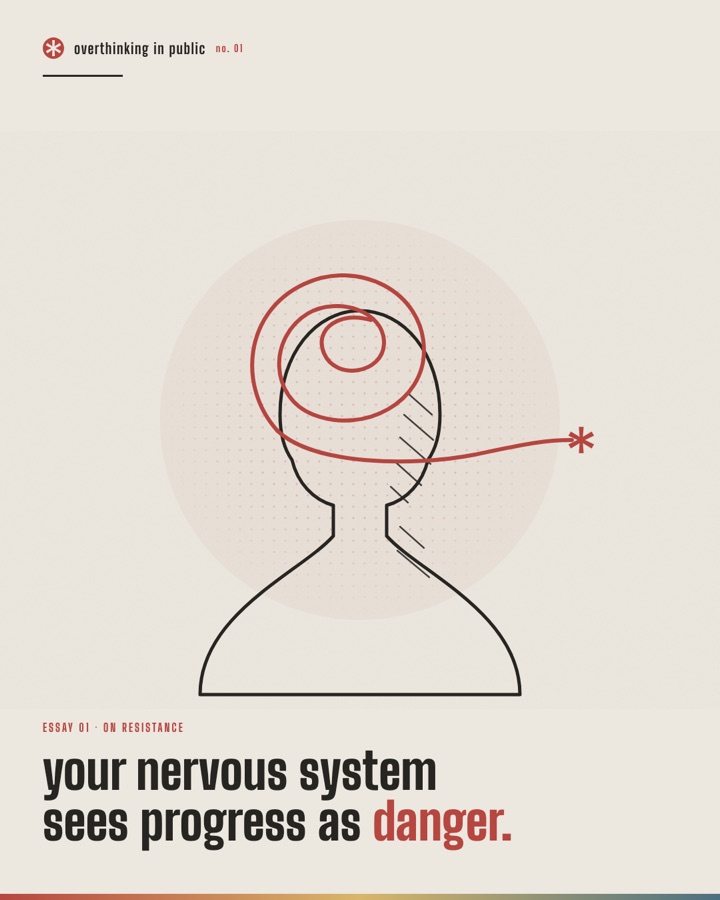
your nervous system sees progress as danger —
and says "f*ck no" to keep you safe.
it thinks it's helping you.
but it's quietly keeping you stuck.
if you've ever felt like you were sabotaging your own success,
this is probably why.
your brain will choose short-term safety over long-term growth —
even when the growth is exactly what you say you want.
where this showed up for me
a few months ago, the universe handed me a masterclass in resistance.
Labour Day weekend.
kids about to go back to school.
a text from our landlords:
"are you around to chat?"
we knew what that meant.
the house sold in five days.
we had sixty days to get out.
we toured more than fifteen places.
only two were in our price range.
both applications were rejected.
and somehow the loudest part of this experience wasn't the housing crisis.
it was the monologue in my head.
Regina George. max volume.
"your parents are offering out of obligation."
"you're 42. how are you moving back home?"
"your wife shouldn't have to live with her in-laws."
every version of resistance was saying the same thing:
do literally anything except the uncomfortable option.
after weeks of spiraling, i finally looked at my wife and said:
"this might sound wild, but i think the universe is telling us to go stay with my parents."
she didn't hesitate.
"i feel the same."
the moment we stopped resisting, everything softened.
the kids get more time with Nana and Poppa.
we get rare time as adults with my aging parents.
we get breathing room to choose the right next step — not a panicked one.
and my parents get to feel needed, which they genuinely love.
around the same time, i read this line in The Surrender Experiment:
"challenging situations create the force needed for change. the problem is that we often use that energy to resist it."
i felt that in my body.
because surrendering didn't mean giving up.
it meant telling the truth about reality and choosing not to fight it.
what i didn't realize then was that this wasn't indecision.
it was my identity defending itself.
why my nervous system said no before i did
here's what was actually happening when resistance kicked in.
uncertainty gets flagged as danger
your amygdala's job isn't to help you grow.
it's to keep you alive.
when something feels uncertain, unfamiliar, or identity-disrupting, your brain fires a threat signal.
it doesn't distinguish between:
"we might have to move in with my parents"
and
"a bear is charging at me."
to your brain, both equal:
this is unsafe. stop immediately.
that's why resistance often starts as a jolt.
a drop in the stomach.
a rush of "don't do it."
your system is confusing change with danger.
your body reacts faster than your logic
polyvagal theory explains that your nervous system makes safety decisions before your conscious mind catches up.
when we got that landlord text, my system went straight into defense mode:
- a full-body uggghhhh
- shallow breathing
- relentless "what ifs"
- catastrophizing every possible outcome
you could call that overreacting.
biologically, it was my vagus nerve saying:
"oh hell no."
it's automatic.
it's fast.
and it feels like truth — even when it isn't.
avoidance gets rewarded
every time you avoid something uncomfortable, you get relief.
that relief triggers dopamine.
your brain learns:
"avoiding this feels good. let's do that again."
so the loop forms:
- avoidance
- procrastination
- "safer" choices
- overthinking without action
even when it quietly screws you long-term,
avoiding reality feels great right now.
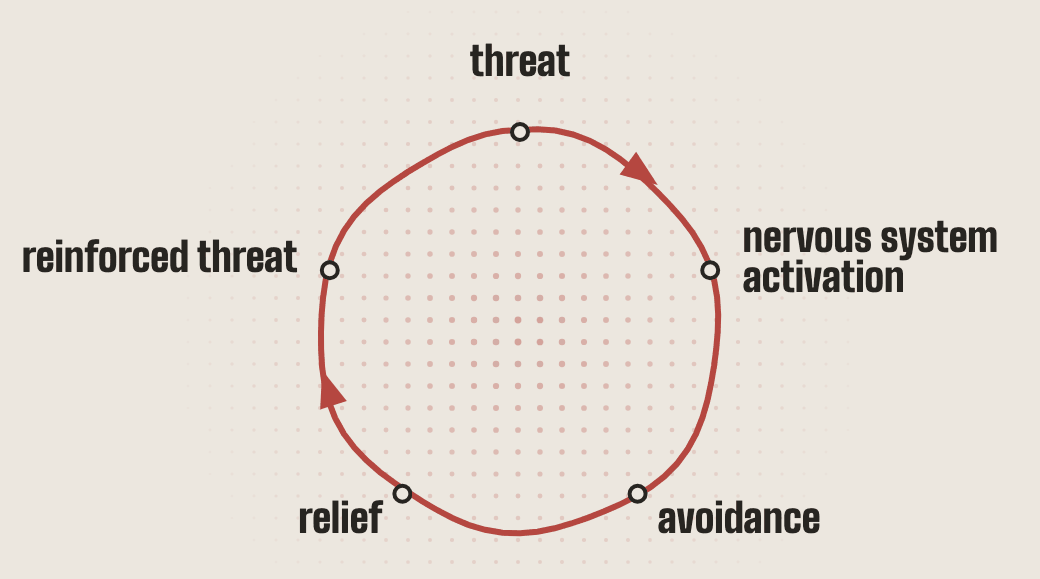
this becomes a loop, not a moment
put it together and you get a predictable pattern:
threat → nervous system activation → avoidance → relief → reinforced threat
no moral failure required.
just biology doing what it was designed to do.
this is why our housing situation felt impossible.
my resistance wasn't about moving.
it was about what moving meant.
the story i was protecting.
the fear of regression.
the shame spiral.
the need to look like someone who "has it together."
my nervous system wasn't wrong.
it was just responding to an outdated version of me.
what i'm choosing to practice out loud
so yes — i'm working through resistance by writing about resistance.
naming the thing is part of surrendering to it.
that's why this is an essay series, not a newsletter.
the word "newsletter" doesn't sit right in my body — and i'm done forcing myself into containers that don't fit just because they're "best practice."
i'm not here to give tips or tricks.
i'm not here to teach you how to build a business.
i'm here to think out loud.
to share real-time reflection, curiosity, fear, insight, and contradiction — in public.
i'll explore AI, neuroscience, personal brand, psychology, storytelling, business, and whatever else i'm genuinely wrestling with.
my only hope is that when overthinking in public lands in your inbox, you feel a little more seen, a little more normal, and a little less alone.
this series is my one consistent act of self-trust.
my experiment in surrender.
my way of choosing truth over performance.
if it serves no one else but me, it will still have done its job.
have a great day, beautiful human.
you've got this.
kristina
pass it on
something land for you? reply to kristina.
get the next one
every essay is published here, free. sign up and you'll get a short note when there's a new one.